
My child is learning to read in French, but we speak Arabic at home: how can I help?
Speaking Arabic at home does not stop your child learning to read in French: keeping your language, speaking it and reading stories in it helps too. You can support their reading in French even without a perfect command of French: listen to them read, talk about the pictures with them, set up a routine, let them hear French voices and work with the teacher.
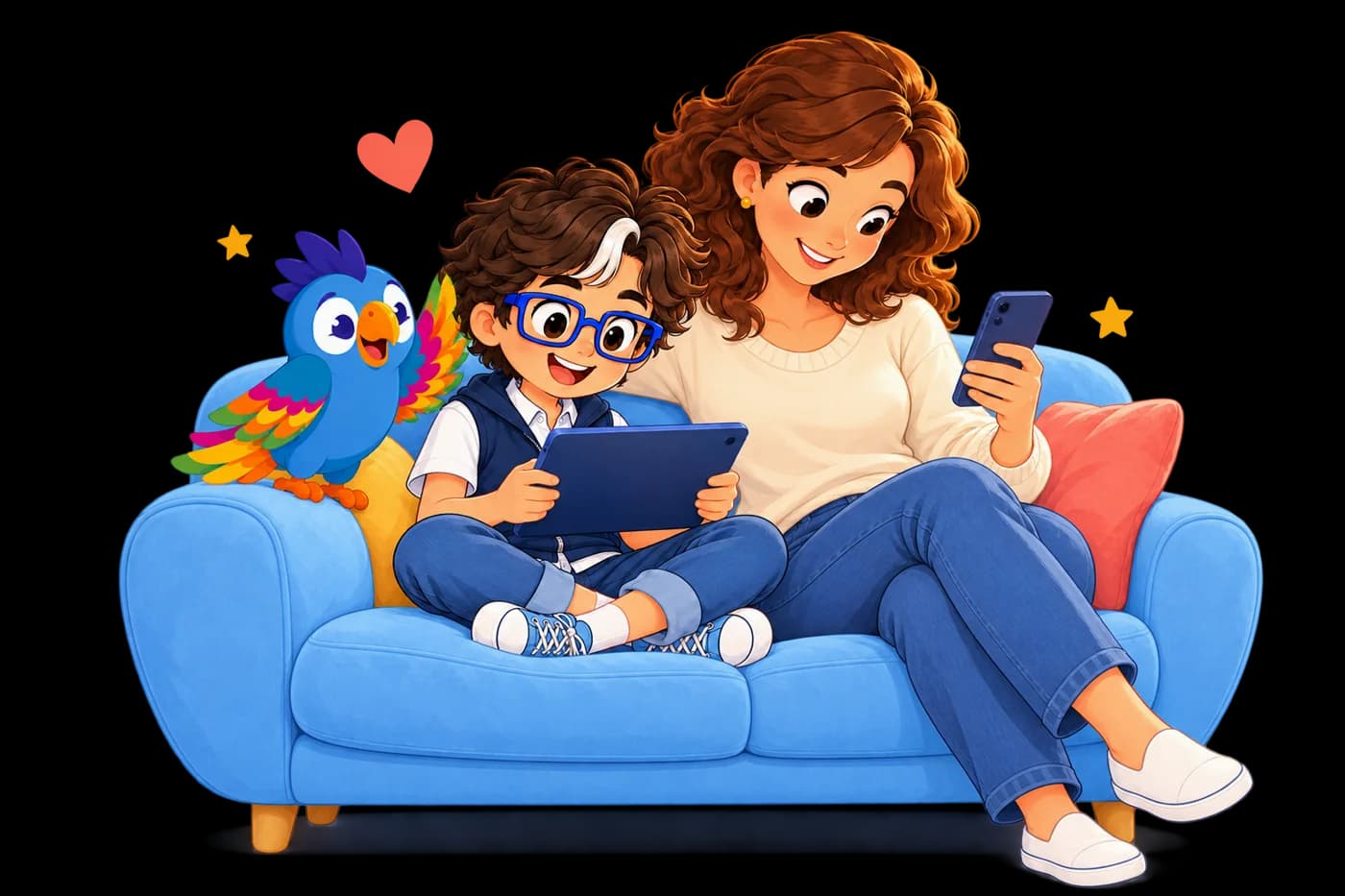
Does speaking Arabic at home stop a child learning to read in French?
You live in Tunis, Sfax, Sousse or elsewhere. At home, you speak Tunisian Arabic (tounsi), Modern Standard Arabic, sometimes several languages at once. And your child is learning to read in French. One question often comes up: “Should I stop speaking Arabic to them to help?”
The answer is no. In a sheet for teachers welcoming pupils whose first language is not French, the French Ministry of Education (DGESCO, 2012) lists among common misconceptions the idea that a family should “speak French at home as soon as possible”. The text explains that this advice, if followed, can disrupt the passing on of the mother tongue, “essential to the child’s development and to learning a second language”.
The same sheet concludes that “maintaining and strengthening skills in the languages in contact is always beneficial”. It also recalls that “you only learn to read once”: a child who can already read in Arabic does not have to learn to read again, they discover another code.
In Tunisia, two cases are common. Your child follows the French curriculum, from CP to CM2 (the first to the fifth year of primary school), and learns to read in French first. Or they follow Tunisian school: they learn to read in Arabic, then discover French as a foreign language. The tips that follow hold in both cases.
How to support a bilingual Arabic-French child?
A rich language at home, whichever it is
What matters is that your child hears a rich language: stories, explanations, discussions, precise words. Tell tales, read picture books in Arabic, talk about their day, explain what you are doing in the kitchen. The words and ideas they build in your language then help them understand what they read in French.
The Ministry’s sheet puts it this way: “the more languages you know, the more languages you can learn, the faster you transfer”. And a speech and language therapy dissertation from the University of Lille (2022) recalls that research has found a transfer of phonological awareness, that is, the ability to hear and handle sounds, from one language to the other.
If your child is also learning to read in Arabic, at school or in a class, encourage both kinds of reading without setting them against each other. Keep a few books in each language at home, let them choose which one they want to read in tonight, and show them you are proud of both their languages. That way you tell them, without a big speech, that both their languages count as much as each other.
Mistakes along the way are normal
Your child will sometimes mix up the sounds or words of the two languages. According to the Ministry’s sheet, these transfers, far from being negative, are “the sign that learning is under way”. There is no need to worry about it or to scold them.
What pronunciation difficulties in French for an Arabic-speaking child?
Arabic and French do not have the same sounds. The dissertation by Manon Buforn, defended at the University of Lille in 2022, draws on linguistics research to compare Modern Standard Arabic and French, recalling that literary Arabic and the spoken Arabic dialects share many features. French has 16 vowels, Modern Standard Arabic 3 short vowels and 3 long vowels. The sounds [p] and [v] exist in Arabic only as variants of other sounds, whereas in French they change the meaning of words: « pain » (bread) and « bain » (bath), « ville » (town) and « fil » (thread) do not mean the same thing.
The dissertation then studied 22 children aged 7 to 11, all seeing a speech and language therapist for a phonological disorder, some bilingual in Arabic and French, others French speakers only. The bilingual children made proportionally more mistakes on sounds specific to French, above all on nasal vowels (« an », « on », « in »), which they more often pronounced without nasality. The author points out that the small number of mistakes did not allow a statistical analysis.
So read this result for what it is: a lead observed in children already being seen for a difficulty, not a rule for all bilingual children. It simply points to the sounds that deserve a little more attention.
Pronouncing nasal vowels: three little games
- The pairs that change everything. Say two French words and ask which one they hear, then the other way round: « beau » and « bon », « mais » and « main », « chat » and « champ », « va » and « vent ».
- The sound hunt. Choose a sound of the day, for example « on ». During the meal, everyone looks for French words that contain it: « maison », « bonbon », « ballon ».
- The sound in the book. While reading, they put a finger under each « an » or « on » they find, and read it aloud.
How to help your child read in French without speaking French well?
Not at ease in French? You still have a lot to give. Here is a 15-minute routine that does not require speaking perfect French.
- Set a fixed time. Same time every evening, same quiet corner, TV and video games off.
- Listen to them read. They read aloud, following the words with a finger. You do not have to correct every word: your attention is enough to show them it matters.
- Talk about the pictures, in your language. “What’s happening here?”, “Why do you think she’s crying?”, “Tell me the story in Arabic.” If they can retell in your language what they read in French, they have understood.
- Let them hear a French voice. Audiobooks from the library, stories read aloud: the Ministry’s sheet in fact advises regular exposure to French through native speakers, on the radio or in recordings.
- Make them the teacher. “Teach me a word you read today.” They are proud, and they revise without realising it.
Reading together, each in your own language, also has its place: one evening a picture book in Arabic, one evening a story in French. To go further, see our article Reading aloud every day, and if your child reads well but seems to lose the meaning, My child reads but does not understand.
How to work with the school?
The teacher is your best ally: their French teacher, if they follow Tunisian school. Do not hesitate to ask for a meeting, even if you fear not finding your words in French. Bring someone close to you if that reassures you.
A few useful questions:
- “Which sounds is my child working on at the moment?”
- “What can I do at home, even if I don’t speak French well?”
- “How does their reading aloud go in class?”
Also tell the teacher which languages are spoken at home. It is not a confession, it is precious information: it helps them understand some of your child’s mistakes, such as a nasal vowel that does not come out yet.
When to worry about reading difficulties in French?
The University of Lille dissertation stresses a risk of overdiagnosis of phonological disorder in bilingual children, and recalls that difficulties seen only in the second language are not enough for that diagnosis: skills in both languages have to be looked at.
If you are worried, because your child also struggles in your language, because reading stays very hard as the months go by, or because they lose heart, talk to the teacher, then to the doctor, who can refer you to a speech and language therapist. Always say which languages are spoken at home.
Frequently asked questions from Arabic-speaking parents
Should you stop speaking Arabic at home?
No. The French Ministry of Education lists the advice to speak French at home as soon as possible among common misconceptions: the mother tongue matters for the child’s development and for learning a second language.
How can you help your child in French if you do not speak French well?
Listen to them read, talk about the pictures and the story in your language, let them hear French voices (audiobooks, stories read aloud) and ask their teacher what you can do at home.
My child mixes the sounds and words of the two languages: is that a problem?
No. According to the Ministry’s guide, these transfers are “the sign that learning is under way”. Talk to the teacher if the difficulties also show in your language, if they do not lessen over the months or if your child is losing heart.
How much time reading in French each day?
A 15-minute session each evening is enough: listen to them read, talk about the story, let them hear a French voice. Regularity matters more than length.
And where does Kalimo fit in?
Kalimo is a French reading app for children aged 5 to 10, with illustrated stories in comic form, written for each school year, from CP to CM2 (the five years of French primary school), following the progression of reading at school.
With “Raconte-moi” (“Tell me”), the story is read by its characters’ voices while your child follows the text: a model of French that helps when you are busy or less at ease in French. Then it is their turn to read aloud while a tutor listens: every word read well turns green, a word misread or skipped turns yellow, without ever blocking them. Listening needs an internet connection, and no recording of their voice is kept.
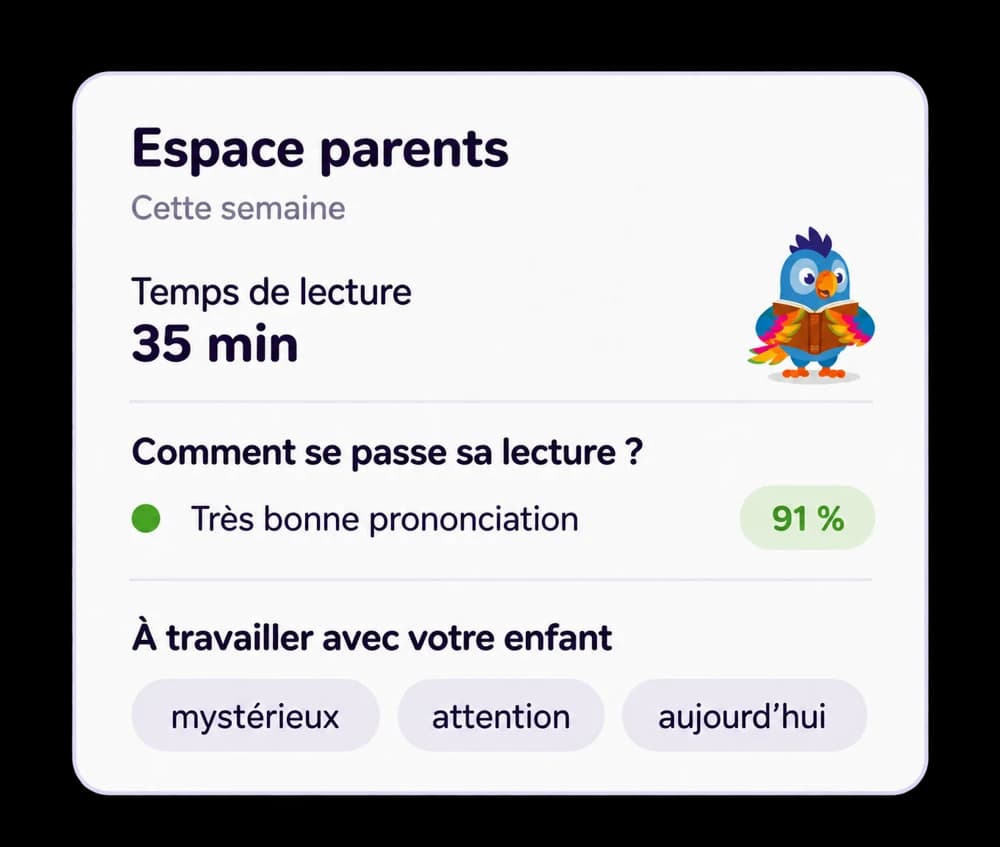
From your parent area, you see their reading time for the week, their pronunciation and the words to work on together. No advertising: create your account on the website.
Sources
- Ministère de l'Éducation nationale (DGESCO), « Dix idées reçues sur l'apprentissage de la langue française », fiches repères pour les élèves allophones nouvellement arrivés, 2012. https://eduscol.education.gouv.fr/sites/default/files/document/eanaflsco10ideesrecues359988pdf-81198.pdf
- Manon Buforn, « Interférences phonologiques en situation de bilinguisme : analyse des erreurs de lecteurs bilingues arabe-français suivis en orthophonie », mémoire d'orthophonie, Université de Lille, 2022. https://pepite-depot.univ-lille.fr/LIBRE/Mem_Ortho/2022/ULIL_SMOR_2022_042.pdf