
My child reads but does not understand what they read: how can I help?
When a child reads without understanding, it is often because decoding still takes all their attention, or because some words escape them. Understanding can be practised: before, during and after reading, with simple questions you can ask tonight.
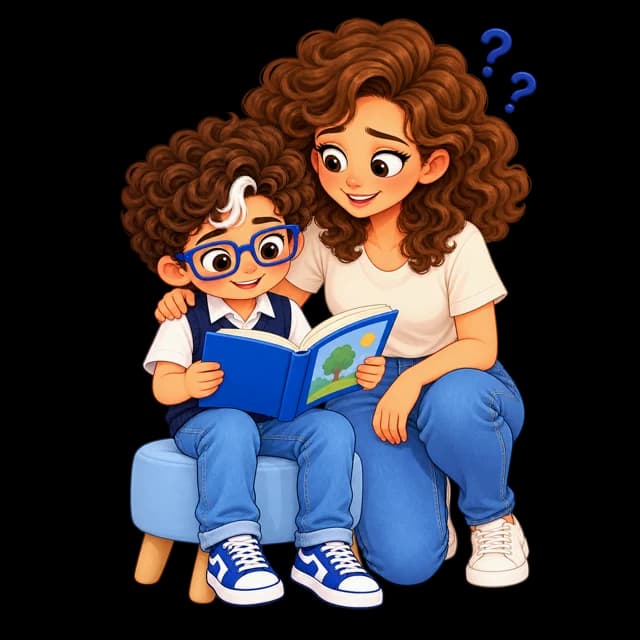
Reading and understanding: two different skills
Your child reads their page without many mistakes. You ask what happened, and they shrug. This often happens in CE1 and CE2 (the second and third years of French primary school, age 7 to 9), and there is an explanation: reading aloud and understanding are not the same skill.
The French official bulletin (Bulletin officiel) of 12 January 2023 recalls it: understanding a text draws on several kinds of knowledge and skill at once, namely decoding, vocabulary, syntax, understanding how texts are organised and cultural knowledge. If one of these pieces is missing, the meaning slips away.
The good news is that each of these pieces can be practised, often at home, in a few minutes.
Why does my child read without understanding?
Decoding takes up all the room
A child who still decodes slowly spends all their energy turning letters into sounds. Éduscol, the teaching website of the French Ministry of Education, explains it in its benchmarks on fluency: pupils whose reading is too slow devote a large share of their attention and working memory to decoding, and they find it harder to understand what they read.
The DEPP, the Ministry’s statistics department, points the same way: automatic decoding frees up resources to build meaning. By the time your child reaches the end of the sentence, they have sometimes forgotten the beginning. It is neither laziness nor a lack of intelligence: it is a question of load.
They read fast, but without stopping on the meaning
The opposite also happens: a child who reads fast and well, but mechanically. Reading fast is not reading well. The American researcher Timothy Rasinski, a fluency specialist, warns precisely against the idea that fluency comes down to reading fast: for him, it links word recognition to comprehension, and is practised with expression and meaning.
That is why fluency tests are not enough to judge understanding. The DEPP says so: they measure automatic decoding, not understanding of the text. To learn more about these tests, read our article Reading fluency in CE1: how many words per minute should a child read?.
Some words escape them
A text can be decoded well and stay obscure because two or three key words are unknown. Yet few words are learnt “in passing”. A meta-analysis by Swanborn and de Glopper (1999), bringing together 20 experiments, estimates that readers learn about 15% of the unknown words they meet while reading. For the others, an explanation or further encounters with the word can help.
If French is not the language of your home, as in many families in Tunisia, this matters even more: your child can decode a word without effort that they have never heard. Explain it in your home language if that is easier, what matters is that they understand. Our article My child is learning to read in French, but we speak Arabic at home: how can I help? gives you more ideas.
The story is about a world they do not know
A story set on a farm, in the mountains or in a castle calls for knowledge that not every child has. The Bulletin officiel in fact lists cultural knowledge among the ingredients of understanding. Talking about the book’s world before reading it can help a lot.
How to improve reading comprehension in CE1 and CE2?
Here are three moments when you can act, before, during and after reading, without turning it into a test.
Before reading: preparing the ground
- Look at the cover, the title and the pictures together. “What do you think it will be about?”
- Spot one or two difficult words and explain them in your own words: “A vegetable patch is a garden where you grow vegetables.”
- Recall what happened the day before if the story continues: “Do you remember where we stopped?”
During reading: stopping to check
- Pause at the end of a page or a paragraph: “What has just happened?”
- If your child struggles to decode, share the effort: you read one page, they read the next. When you read, all their attention can go to the meaning.
- Encourage them to reread a passage when they get lost: rereading is not a failure, it is what good readers do.
After reading: the questions that really help
Avoid questions answered by yes or no. Vary the kinds of question instead:
- Retelling: “Tell me the story in your own words, as if I hadn’t read it.”
- Finding: “Where does the story take place? Who is the main character?”
- Understanding what is not written: “Why do you think the character is cross? How do you know?”
- Linking to their life: “Has that ever happened to you?”
- Giving their opinion: “What would you have done in their place?”
The third family matters a lot. The Bulletin officiel asks that pupils be taught to draw out the main ideas of a text, explicit or implicit. A child who only understands what is written in black and white misses part of the story.
How to enrich your child’s vocabulary to understand better?
Since reading alone is not enough to fix most new words, your help counts. The principle: explain the word, then have your child come across it again several times, in varied situations. At home, it can look like this:
- While reading, stop on a new word and ask: “What do you think it means?”
- Give a simple explanation, with an example from your child’s life.
- Use the word again during the week, at a meal or in the car: “Remember the vegetable patch? We saw one today.”
- Write the new words in a small notebook that your child can illustrate.
Also keep reading them stories a little richer than the ones they read alone. They hear new words without having to decode them, and you can talk about them together. Our article Reading aloud every day suggests a simple routine.
5 mistakes to avoid when your child does not understand what they read
- Turning every reading into a test. One or two questions are enough, and the pleasure of the story comes first.
- Asking them to reread everything when they have not understood. Better to target the passage that causes trouble.
- Choosing a text that is too hard. If decoding is laborious, take a simpler text: understanding will follow more easily.
- Pushing them to read faster to “save time”. Rushed reading loses the thread.
- Concluding too quickly that they “understand nothing”. Often, they understand part of it: start from there.
My child in CE2 does not understand what they read: when to worry?
It is normal for a child in CE1 or CE2 not to grasp everything. Talk to the teacher if, despite a few weeks of supported reading:
- your child almost never manages to retell the gist of a text at their level;
- reading stays very slow and hard work;
- they understand a story read to them well, but not one they read alone, and the gap does not narrow.
The teacher sees your child read every day and can tell you where the difficulty lies: decoding, vocabulary or understanding. If a difficulty persists, talk to the teacher, then to the doctor, who can refer you to a speech and language therapist.
Frequently asked questions about reading comprehension
Why can my child read but not understand?
Often, decoding still takes all their attention, or a few key words are unknown to them. They may also read fast without stopping on the meaning, or lack knowledge about the world of the story.
What questions should you ask after reading?
Open questions rather than yes or no: have them tell the story in their own words, find who and where, guess what is not written (“why is he angry?”), link it to their life and give their opinion.
What comprehension exercises can you do at home?
No worksheets needed: look at the cover and guess the subject before reading, pause at the end of a page during reading, tell the story afterwards, and note new words in a small notebook they illustrate.
And where does Kalimo fit in?
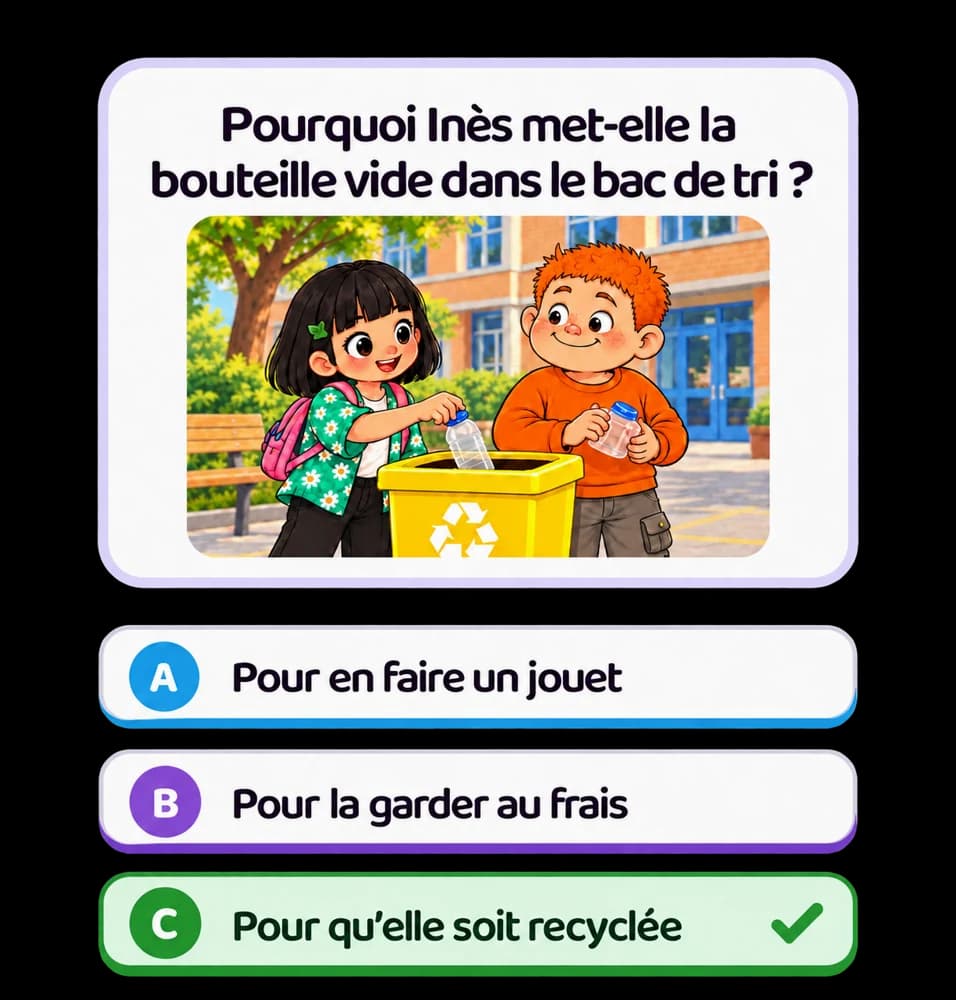
Kalimo is a French reading app for children aged 5 to 10. Its stories are comics, arranged in one reading world per school year, from CP to CM2, and written to follow the progression of reading at school.
After each story, your child answers a quiz of comprehension questions and plays games around the story’s words (listening, missing letter, building a word, completing a sentence, matching, memory).
When decoding takes up too much room, “Raconte-moi” (“Tell me”) reads the story with the characters’ voices while your child follows the text. From your parent area, you see the words to work on with them. Kalimo replaces neither the teacher nor a speech and language therapist, and has no advertising. To try it: Create an account.
Sources
- Ministère de l'Éducation nationale, « Renforcer la maîtrise des savoirs fondamentaux des élèves en CM1, CM2 et 6e (cycle 3) pour faciliter leur entrée au collège », Bulletin officiel n° 2, 2023. https://www.education.gouv.fr/bo/23/Hebdo2/MENE2300947N.htm
- Éduscol, « Évaluations nationales de début de 6e : repères pour travailler la fluence », 2026. https://eduscol.education.gouv.fr/sites/default/files/document/evaluationdebut6efrancaisreperestravaillerfluence-130222.pdf
- DEPP, ministère de l'Éducation nationale, « Fluence de lecture : une dynamique d'apprentissage plus forte à l'école qu'au collège », Note d'information n° 26.31, 2026. https://www.education.gouv.fr/sites/default/files/document/deppni-2026-31fluence-de-lecturepdf-518870.pdf
- The Reading Teacher, T. V. Rasinski, “Why Reading Fluency Should Be Hot!”, 2012. https://ila.onlinelibrary.wiley.com/doi/10.1002/TRTR.01077
- Review of Educational Research, M. S. L. Swanborn and K. de Glopper, “Incidental Word Learning While Reading: A Meta-Analysis”, 1999. https://journals.sagepub.com/doi/10.3102/00346543069003261