
Reading aloud with your child: 7 tips to progress every day
Reading aloud with your child helps them progress in two ways: when you read them a story, they hear what fluent reading sounds like, and when they reread a text several times themselves, their reading grows surer. Here is why it works, then 7 tips for going about it, in a quarter of an hour each evening.

Why does reading aloud help children progress?
Reading aloud is not just a school exercise. It is one of the best-studied ways of helping a child read with ease, what teachers call fluency.
In 2000, the National Reading Panel, a group of American experts whose report is published by the US National Institute of Child Health and Human Development (NICHD), reviewed the research on learning to read. Its conclusion on fluency is clear: guided repeated oral reading, with help from teachers, peers or parents, has a significant and positive effect on word recognition, fluency and comprehension, across school years.
The same panel found no positive link between programmes that only encourage a lot of independent silent reading, with little guidance, and progress in reading. The panel points out that this does not prove reading alone is useless: the available studies did not allow a conclusion. The positive effect of guided reading aloud, on the other hand, was measured.
A meta-analysis by William Therrien (2004), bringing together 18 studies on repeated reading with pupils aged 5 to 18, including pupils with learning disabilities, points the same way. It finds average effect sizes of 0.75 on fluency and 0.73 on comprehension, according to the summary given by the American Speech-Language-Hearing Association (ASHA).
French schools have made the same choice. The French official bulletin (Bulletin officiel) of 12 January 2023 asks that, during CM1 and CM2 (the last two years of primary school, age 9 to 11), all pupils read aloud every day to practise their fluency. What you do in the evening therefore extends what is done in class.
In Tunisia, these tips hold in both cases: whether your child follows the French curriculum, from CP to CM2 (the first to the fifth year of primary school), or Tunisian school, where French is learnt as a foreign language. In the second case, choose texts at their level in French, even if they seem meant for younger children: what matters is that they can read them without stumbling at every word.
7 tips for reading aloud with your child
1. Read them stories, even once they can read
When you read aloud, your child hears what they cannot yet produce alone: the pauses at full stops, the voice rising at a question, the tone of an angry character. Among the activities Éduscol, the teaching website of the French Ministry of Education, suggests for practising fluency is in fact repeated reading with a recording of the text: the pupil listens to the text while reading it aloud.
It is tempting to stop reading to your child as soon as they can decode. That would be a pity: you can read them books richer than the ones they read alone. They discover stories, words and turns of phrase they would not yet meet in their own reading, and all their attention goes to the meaning.
2. Let them choose the book
Let them choose the book from time to time. Éduscol, writing about the quarter of an hour of reading at school, recalls that the freedom to choose one’s book, whether a novel, a non-fiction book or a comic, makes it easier to make it one’s own.
3. Choose a short passage, at their level
For your child to read themselves, rely on repeated reading: rereading the same short passage several times until it reads with ease. Choose a few sentences, up to half a page, in a book at their level.
4. Show the way, then read together
- First read the passage aloud, following the text with your finger if your child is in CP or CE1.
- Then read it together, at the same time. According to Éduscol, this “reading in unison” particularly suits pupils who need to gain confidence.
5. Have them reread the same passage
Your child then reads the passage alone, two or three times. They feel for themselves that it is getting easier. End with a question about the meaning and a precise compliment: “This time, you did the wolf’s voice, we were really scared!”
If they tire quickly, read in turns: one sentence each, or one paragraph each. Éduscol suggests this sharing for pupils with language or learning disorders, to avoid a long and tiring activity; the idea can serve any child who tires quickly.
6. Set up a regular quarter of an hour
What matters most is not the length, it is the regularity. A quarter of an hour a day, at the same time, soon becomes a habit. At school, the “quarter of an hour of reading” presented by Éduscol rests on the same idea: a short reading time, set into the timetable.
An example evening, in a quarter of an hour:
- Five minutes of repeated reading on a short passage.
- Five minutes where you read the rest of the story, while your child looks at the pictures or follows the text.
- Five minutes to talk about it: what they liked, what they think will happen.
A few tips to make the routine last:
- Choose a calm moment, not right after an argument nor when they are falling asleep.
- Stop before they are tired: better to finish wanting more than with a sigh.
- On hard evenings, cut it down to one page rather than skip the session.
7. Correct little, praise precisely
This is often where everything plays out. A child who feels corrected at every word ends up not wanting to read. For repeated reading, Éduscol recommends targeted feedback in a kind setting, taking care not to interrupt the reading too often.
- Wait a few seconds. Often, your child corrects themselves: that is a win, tell them so.
- If the mistake changes the meaning, point to the word: “Look closely at this word, can you read it again?”
- If the mistake does not change the meaning, let it go and come back to it at the end.
- After reading, work on one or two words only, not ten.
- Praise the effort precisely: “You read that hard word all by yourself, well done.”
Phrases to avoid: “Come on, we saw it yesterday!”, “You’re not paying attention” or a heavy sigh. Prefer: “This word is hard, let’s look at it together.”
My child does not dare read aloud: how can I help?
Some children freeze as soon as someone listens. It is not a whim: reading in front of someone means risking a mistake. A few ideas:
- Start by reading in unison with them: their voice blends with yours, no one hears them alone.
- Suggest they read to their cuddly toy, the cat or a little brother, without you in the room.
- Have them read a passage they already know well, so they are sure to succeed.
- Suggest they record themselves and listen back. Éduscol mentions practising with audio recordings, so that the pupil gets familiar with the text before reading it in front of others when they feel ready.
- Do not make them read in front of the family if they do not want to.
If the refusal is very strong or lasts, talk to the teacher, then to the doctor, who can refer you to a speech and language therapist.
To find out where your child stands, read our article on fluency and words per minute. And if their reading is fluent but the meaning escapes them, see My child reads but does not understand.
Frequently asked questions about reading aloud
How long should you read aloud each day?
A quarter of an hour is enough, as long as it comes back every day, at the same time. Regularity matters more than length, and one page on hard evenings is better than no reading at all.
Reading aloud or silent reading: which helps more?
For fluency, research has measured the effect of repeated reading aloud guided by a teacher, a classmate or a parent. Reading silently alone is not useless, but the National Reading Panel could not conclude that it brings progress on its own.
Should you correct every reading mistake?
No. Give them a few seconds to correct themselves, point out only the mistakes that change the meaning, and work on one or two words at the end rather than interrupting at every word.
Should you keep reading stories to a child who can read?
Yes. You can read them books richer than the ones they read alone: they hear new words and turns of phrase, and keep a model of fluent reading.
And where does Kalimo fit in?
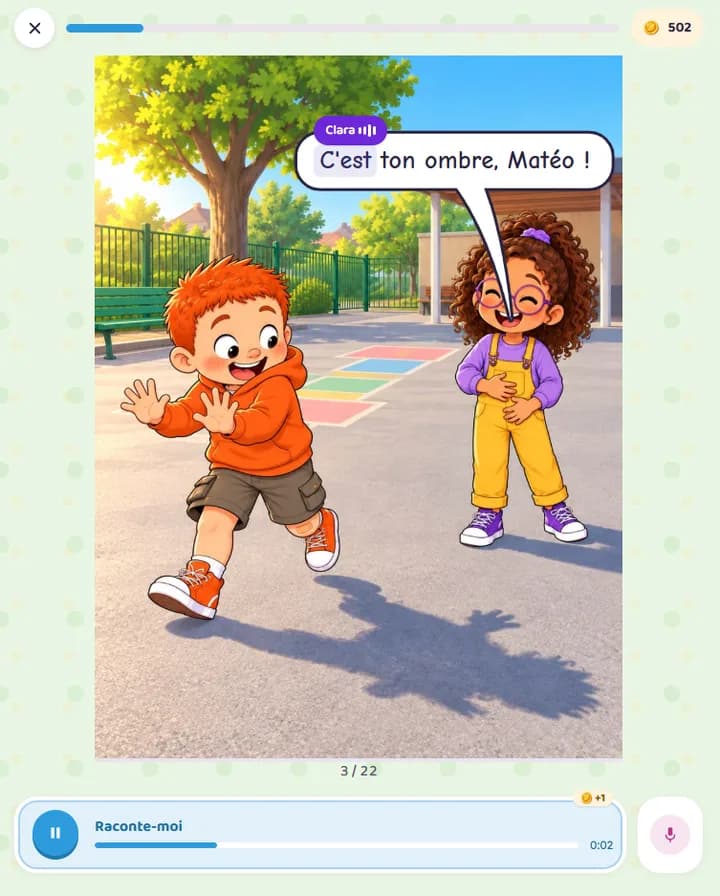
Kalimo is a French reading app for children aged 5 to 10, with comic stories arranged in one reading world per school year, from CP to CM2.
It covers both sides of reading aloud. With “Raconte-moi” (“Tell me”), the story is read by its characters’ voices while your child follows the text: a model in French, useful on evenings when you are busy or if you are less at ease in French. With the tutor that listens, your child is the one reading the page: every word read well turns green, a word misread, skipped or left silent turns yellow, and the next word lights up. The tutor never blocks them and never says the word by itself; your child can, if they wish, tap a word to hear it. Listening needs an internet connection, and no recording of the voice is kept.
No advertising. To try it: Create an account.
Sources
- NICHD, “Report of the National Reading Panel: Findings and Determinations”, 2000. https://www.nichd.nih.gov/publications/pubs/nrp/findings
- ASHA Evidence Maps, summary of W. J. Therrien, “Fluency and Comprehension Gains as a Result of Repeated Reading: A Meta-Analysis”, Remedial and Special Education, 2004. https://apps.asha.org/EvidenceMaps/Articles/ArticleSummary/903ec865-92fd-4ca5-9cea-8534b161420a
- Ministère de l'Éducation nationale, « Renforcer la maîtrise des savoirs fondamentaux des élèves en CM1, CM2 et 6e (cycle 3) pour faciliter leur entrée au collège », Bulletin officiel n° 2, 2023. https://www.education.gouv.fr/bo/23/Hebdo2/MENE2300947N.htm
- Éduscol, « Évaluations nationales de début de 6e : repères pour travailler la fluence », 2026. https://eduscol.education.gouv.fr/sites/default/files/document/evaluationdebut6efrancaisreperestravaillerfluence-130222.pdf
- Éduscol, « Le quart d'heure de lecture ». https://eduscol.education.gouv.fr/6336/le-quart-d-heure-de-lecture