
Reading fluency in CE1: how many words per minute should a child read?
At the end of CP, a child is expected to read at least 50 words correctly in one minute, then about 70 at the end of CE1 and 90 at the end of CE2. These fluency benchmarks measure ease of reading, not understanding: here is how to read them, measure your child’s fluency without stress and help every day.

What is reading fluency?
Fluency is the ability to read a text aloud accurately, at the pace of conversation, with suitable intonation. That is how Éduscol, the teaching website of the French Ministry of Education, defines it.
In practice, it is measured by counting the words read correctly in one minute (in French, MCLM, “mots correctement lus par minute”). A word skipped, misread or replaced does not count.
Why does school care so much? Because a child who still sounds out every syllable spends all their attention on decoding. According to the DEPP, the Ministry’s statistics department, automatic decoding frees up resources to build the meaning of the text. Fluent reading is not a goal in itself: it is what leaves room to understand.
A note on school years: in France, CP is the first year of primary school (age 6 to 7), followed by CE1, CE2, CM1 and CM2 (age 10 to 11), then 6e, the first year of secondary school.
Reading fluency: how many words per minute from CP to CM2?
How many words per minute at the end of CP?
The best-known benchmark is for the end of CP: reading at least 50 words correctly in one minute. It is the end-of-CP expectation the DEPP recalls in its July 2026 information note on fluency.
And then, from CE1 to CM2?
Éduscol publishes the end-of-year expectations, given as the number of words read correctly in one minute, on average at the end of the year:
The French official bulletin (Bulletin officiel) of 12 January 2023 points the same way. It asks that pupils starting CM1 who do not yet read fluently and expressively, at about 90 words per minute, get specific daily practice for at least four weeks. It aims for an average of 120 words per minute at the end of CM2, then 130 at the end of 6e.
And in Tunisia?
These benchmarks are those of French schools, for children who learn to read in French from CP, the equivalent of the first year of primary school, around age 6. If your child follows the French curriculum, they apply as they are. If they follow Tunisian school, where French is learnt as a foreign language, they are not made for them: compare them with themselves instead, from one measurement to the next, with the method below.
What is a normal fluency score?
The French national assessments give an idea of reality. According to the DEPP, in September 2025, pupils starting CE1 in France read on average 49 words in one minute. Applying the end-of-CP expectation (50 words), 40.3% of them reached it. At the other end, 8.6% already read 100 words or more.
For the start of CE1, the French national assessments in fact use a lower threshold, 30 words read correctly in one minute: with that threshold, 67.5% of pupils have a level judged satisfactory, again according to the DEPP. At the start of CE1, many children are therefore still on their way, and the gaps between them are wide.
Progress, on the other hand, is fast: according to the DEPP, the largest gap between two successive years lies between the start of CE1 and the start of CE2 (37 words). A “normal” score is therefore less a number than a trajectory: what matters is that your child moves forward over the months.
How to measure your child’s fluency at home?
You can make the same measurement as the teacher, in a gentle version: not to grade your child, but to see their progress.
- Choose a text at their level that they have never read: a page from a book used in their class or a story suited to their age. For the French national assessments, each pupil reads a text written for their school year, whose meaning is within reach of most.
- Settle somewhere quiet and present it as a game: “Let’s see how many words you read in one minute. It’s not a mark, it’s to see your progress in a few weeks.”
- Start a one-minute timer. Your child reads aloud, at their own pace, while you follow on a copy or over their shoulder.
- Do not correct during the minute. Simply note the words skipped or misread. If your child corrects themselves, we suggest counting the word as right: going back over a word is a good habit.
- At the end, count the words read and take away the errors: you get the number of words read correctly in one minute.
- Write down the date and the score in a small notebook. Measure again in four to six weeks, with another text of the same level.
Éduscol in fact suggests that teachers keep a logbook where the pupil follows their progress: your small notebook plays the same role.
What the score does not tell you
The DEPP is clear: fluency tests assess automatic decoding, through speed and accuracy. They assess neither understanding of the text nor oral interpretation. A child can read fast and not remember the story. Another, slower, may have understood everything.
So after the measurement, ask a small question: “What happens in this passage?” If the meaning escapes them, our article My child reads but does not understand what they read gives you practical ideas.
Nor does the score tell you whether your child likes reading: it is a snapshot of one moment.
How to improve reading fluency? A 10-minute routine
Research is fairly clear on what improves fluency: reading the same text aloud several times, with an adult’s help. The US National Reading Panel (2000) concluded that guided repeated oral reading, with support from teachers, peers or parents, has a significant and positive effect on word recognition, fluency and comprehension. Éduscol’s sheet on fluency also lists repeated reading among the activities to offer.
Here is a simple routine, for the evening or after school:
- Minutes 1 and 2: you read the passage aloud (half a page is enough) while your child follows with their eyes. They hear what fluent reading sounds like.
- Minutes 3 and 4: you read together, at the same time. According to Éduscol, this “reading in unison” particularly suits pupils who need to gain confidence.
- Minutes 5 to 8: your child reads the same passage alone, two or three times. With each reading, they gain ease.
- Minutes 9 and 10: a question about the meaning, then a precise and positive closing word: “Did you hear? The third time, you paused at the full stop, it was much smoother.”
Change passage once they read it with ease. To go further, read our article Reading aloud every day.
Mistakes to avoid
- Making the stopwatch a daily ritual. One measurement a month is plenty.
- Pushing them to read fast. Rushed reading skips words and loses the meaning: aim for steady, expressive reading.
- Correcting every word. For repeated reading, Éduscol recommends targeted feedback in a kind setting, taking care not to interrupt the reading too often.
- Comparing with a brother, a sister or a classmate. The national assessments show wide gaps between children in the same school year.
- Choosing a text that is too hard. If your child stumbles over many words, take a simpler text: it is not a step back, it is the right level of practice.
Low fluency: when to talk to the teacher?
The teacher is the first person to talk to. In the French curriculum, from CE1 to CM2, they run the national fluency assessments at the start of the year, and they see your child read every day. Make an appointment if, despite regular practice at home:
- reading stays very choppy, syllable by syllable, several months after the start of the year;
- the score does not move from one measurement to the next for several months;
- your child avoids reading, tires very quickly or loses heart as soon as they have to read.
You can ask: “Where is my child compared with what you expect at the end of the year? What can I do at home that goes the same way as you?” If a difficulty persists, talk to the teacher, then to the doctor, who can refer you to a speech and language therapist.
Frequently asked questions about reading fluency
How many words per minute should a CE1 child read?
About 70 words read correctly in one minute at the end of CE1, according to the expectations published by Éduscol. In France, at the start of CE1, pupils read 49 on average in September 2025, according to the DEPP: the goal is built over the year.
How do you calculate a fluency score?
Have them read aloud an unseen text at their level for one minute, count the words read and take away the words skipped or misread. The result is the number of words read correctly per minute.
What is the difference between fluency and comprehension?
Fluency measures the speed and accuracy of decoding. Comprehension is grasping the meaning of the text: according to the DEPP, fluency tests do not assess it. Fluent reading helps understanding, but does not guarantee it.
Should you time your child every day?
No. One measurement a month is enough to see progress. The rest of the time, practise without a stopwatch, with repeated reading.
And where does Kalimo fit in?
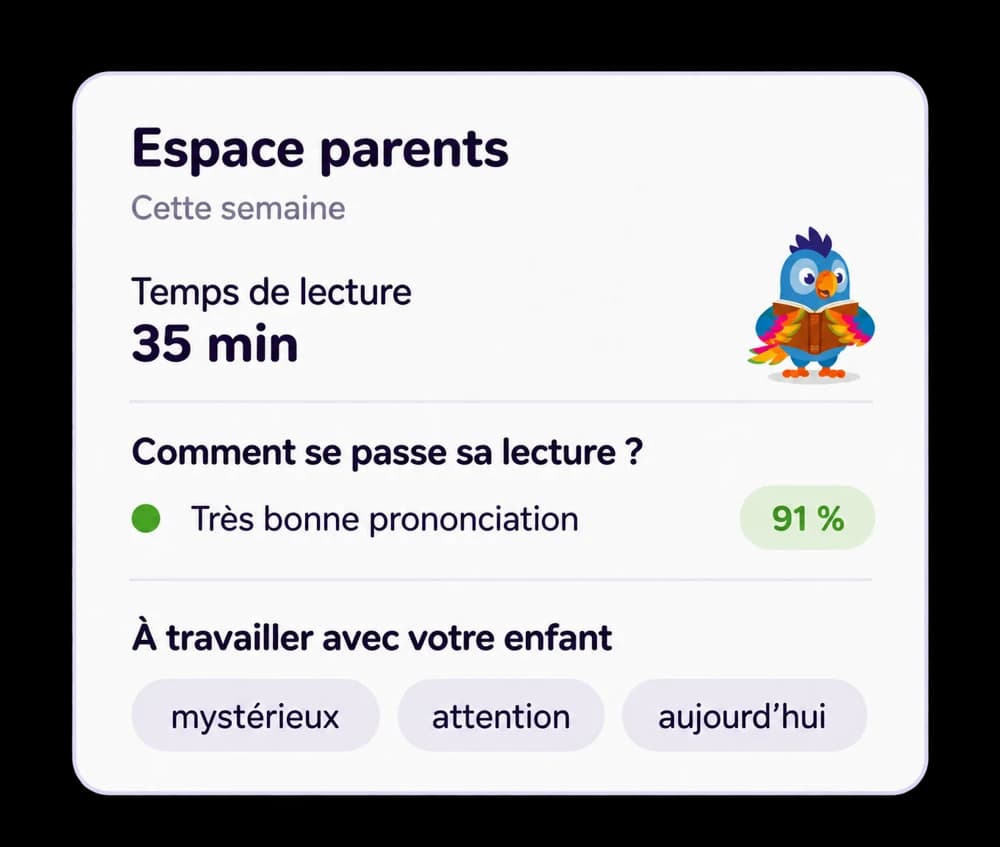
Kalimo is a French reading app for children aged 5 to 10. Its stories are comics, arranged in one reading world per school year, from CP to CM2, and written to follow the progression of reading at school.
For fluency, Kalimo offers a tutor that listens: your child reads the page aloud and every word read well turns green. A word misread, skipped or left silent turns yellow, and the next word lights up. The tutor never blocks the child and never says the word by itself; your child can, if they wish, tap a word to hear it. Listening needs an internet connection, and no recording of the voice is kept.
From your parent area, you see the week’s reading time, the pronunciation and the words to work on together. Kalimo replaces neither the teacher nor the measurement made in class: it is extra practice, with no advertising. To try it: Create an account.
Sources
- DEPP, ministère de l'Éducation nationale, « Fluence de lecture : une dynamique d'apprentissage plus forte à l'école qu'au collège », Note d'information n° 26.31, 2026. https://www.education.gouv.fr/sites/default/files/document/deppni-2026-31fluence-de-lecturepdf-518870.pdf
- Éduscol, « Évaluations nationales de début de 6e : repères pour travailler la fluence », 2026. https://eduscol.education.gouv.fr/sites/default/files/document/evaluationdebut6efrancaisreperestravaillerfluence-130222.pdf
- Ministère de l'Éducation nationale, « Renforcer la maîtrise des savoirs fondamentaux des élèves en CM1, CM2 et 6e (cycle 3) pour faciliter leur entrée au collège », Bulletin officiel n° 2, 2023. https://www.education.gouv.fr/bo/23/Hebdo2/MENE2300947N.htm
- NICHD, “Report of the National Reading Panel: Findings and Determinations”, 2000. https://www.nichd.nih.gov/publications/pubs/nrp/findings