
Regional accent and learning to read: how to help your child?
Your child has always spoken French, but says some words the way people say them where they live. Is a regional accent an obstacle to learning to read? No: it is a normal way of speaking French. Here is why, which sounds really take effort, and how to help your child read well without trying to erase their accent.

Why is French spoken with different accents?
French is not pronounced the same way everywhere in France
French is heard all over France, but not with the same music. The linguist Mathieu Avanzi ran large online surveys, answered by thousands of French speakers, to map these differences. His maps show that words such as « persil », « moins », « vingt » or « brun » are not pronounced the same way from one region to another.
The best-known example is « rose ». In the north of France, it is often said with the closed o of « beau »; in the south, with the open o of « dormir ». Both pronunciations are written with the same letters, and both are French.
Regional accent, pronunciation and vocabulary: what is the difference?
Three things often get mixed up:
- The accent: the overall music, the rhythm and melody of the sentence.
- Pronunciation: the way certain sounds are said, like the o in « rose ».
- Vocabulary: the words themselves. Depending on the region, people ask for a « chocolatine » or a « pain au chocolat ».
On that last example, Mathieu Avanzi's team surveyed more than 10,000 French speakers who grew up in France, Belgium or Switzerland. Their maps confirm where « chocolatine » is used, in the south-west, and show that « petit pain au chocolat » is heard in the north and east. Many other pairs could be named, such as a « sac » or a « poche » to carry the shopping.
A regional accent is not a mistake in French
For linguists, none of these ways of speaking is « wrong ». Asked which variant is the most correct, Mathieu Avanzi answers that there is not one correct variant, but several. A child who says « rose » the way people around them say it is not making a mistake: they speak the French of home.
What matters for reading and writing is something else: knowing how to link letters to sounds, and understanding words and sentences. That is what the rest of this article is about.
Can a regional accent affect learning to read?
The short answer: a regional accent does not stop a child from learning to read. The French school curriculum nowhere asks for it to be erased. It asks children to learn the links between letters and sounds, the same for every pupil.
Learning to match letters to sounds
To learn to read in French, your child must understand that letters, alone or in groups (graphemes), stand for sounds (phonemes), and that putting these sounds together makes words. The school curriculum makes this the base of all learning: these are the sounds and letters of French, or grapheme-phoneme correspondences.
This learning rests on phonological awareness, the ability to notice and play with the sounds of the language: hearing that « moto » splits into « mo » and « to », or that « lune » starts with the sound l. It is built from nursery school onwards, and the curriculum asks for it to be strengthened for the pupils who need it.
When the same word is pronounced differently from region to region
Take « rose » again. Whether they say it with the o of « beau » or the o of « dormir », your child sees the same letters, r, o, s, e, and learns to link them to their own way of saying the word. The written word does not change from one region to another: that is exactly what lets every French speaker read the others.
What takes effort, for every child whatever their accent, is that French spelling sometimes writes the same sound in several ways: é in « été », er in « manger », ez in « nez ». The difficulty weighs mostly on writing: to read, you go from letters to sounds; to write, you must choose the right letters for a sound you hear.
Why a regional accent is not a reading disorder
An accent is shared: family, neighbours and classmates often speak the same way. A reading disorder, such as dyslexia, is a lasting difficulty in learning to read that persists despite suitable teaching. They are not the same thing, and only a professional can speak of a disorder.
The sounds of French that can be hard for children
Some sounds are very alike and need an attentive ear. The French curriculum stresses it: by the end of CE1 (the second year), pupils must have memorised every link between letters and sounds, « en particulier celles des sons proches » (especially those of close sounds).
Telling close sounds apart: « é » and « è », « an » and « on »
The é of « été » and the è of « mère » are two neighbouring sounds; in writing, they are also told apart by their accent marks, which the curriculum asks children to identify and name from CP. The sounds an and on are two nasal vowels: you hear them in « banc » and « bon », « dent » and « don », « lent » and « long ».
These pairs of words, which differ by a single sound, make a good playground. If your child says one of these sounds the way their region does, what matters is that they tell the words apart and know which letters write them.
Recognising sounds inside words
Before writing a sound, you have to hear it in the word. A few simple questions train that ear: « Do you hear an in maman? And in moto? », « Where is the sound on in ballon: at the start or the end? », « Find a word that starts like bateau. »
Learning to pronounce without trying to erase their accent
To improve pronunciation in French, the aim is not to make your child speak like a radio presenter: a child's French pronunciation naturally carries the colour of their region. The aim is for them to articulate clearly, tell apart words that sound alike and make themselves understood. Their accent can stay; it is their voice.
How to help your child read and pronounce words better?
Listening regularly to stories read aloud
When you read a story aloud, your child hears words they do not say yet, well-built sentences, a character's tone. Vary the voices: yours, a grandparent's, an audiobook's. They discover that the same word can sound a little different and still be the same word.
To go further, read our tips for reading aloud with your child.
Playing with sounds and syllables
- Clap out the syllables: « ta-bou-ret », three syllables.
- Look for rhymes: « What rhymes with bateau? Château, gâteau... »
- Play « I hear it, I do not hear it » with a chosen sound, for example on.
- Offer pairs of words that differ by one sound: « banc » or « bon »? « poisson » or « poison »?
Reading together 10 to 15 minutes a day
A short moment every day is worth more than a long session now and then. Ten to fifteen minutes are enough: your child reads a passage at their level, you read what comes next, then you talk about it together. At school, the « quart d'heure de lecture » (quarter of an hour of reading) described by Éduscol rests on the same idea of a short, regular time.
Encouraging your child without constantly correcting their accent
A child who is corrected at every word ends up doubting the way they speak. Linguists call it linguistic insecurity: the feeling of not speaking one's own language « properly ». It is not the right frame of mind for learning to read.
- Tell the accent apart from a reading mistake. A more open o in « rose » is not a mistake; reading « bon » instead of « banc » is.
- When a mistake changes the meaning, point at the word: « Look at this word carefully, can you read it again? »
- Praise precisely: « You read that hard word well, well done. »
The school's role in learning sounds and reading
Learning the links between letters and sounds in CP
In CP, learning the links between letters and sounds is, according to the curriculum, « systématique, intensif, structuré et quotidien » (systematic, intensive, structured and daily), at a pace of about two correspondences a week. By the end of CP, pupils can decode every word and read the most frequent ones without effort. Throughout CP, CE1 and CE2, they read texts aloud every day.
Respecting the many ways of speaking French
It has not always been so. Mathieu Avanzi recalls that at the start of the 20th century, pupils were punished for using words of patois at school. Today, the question of regional French at school looks different: school teaches one written code to everyone, and a pupil can learn it with the accent of their region.
When to see the teacher or a speech therapist?
Not every pronunciation difficulty in a child comes from their accent. Talk to the teacher first if your child:
- keeps mixing up sounds that the people around them tell apart;
- struggles to decode simple words while the class moves on;
- is hard for other children of their age to understand;
- avoids reading, tires very quickly or gives up.
The teacher sees your child read every day and can compare with the other pupils. If the difficulty lasts, talk to the doctor, who can check their hearing and refer them to a speech therapist.
How does Kalimo Kids support young French readers?
Discovering illustrated stories suited to each level
Kalimo is a French reading app for children aged 5 to 10. Its stories are comics, arranged in one reading world per school year, from CP to CM2 (the first to the fifth year of primary school), and written to follow the way reading progresses at school.
Listening to the characters to enrich the reading experience
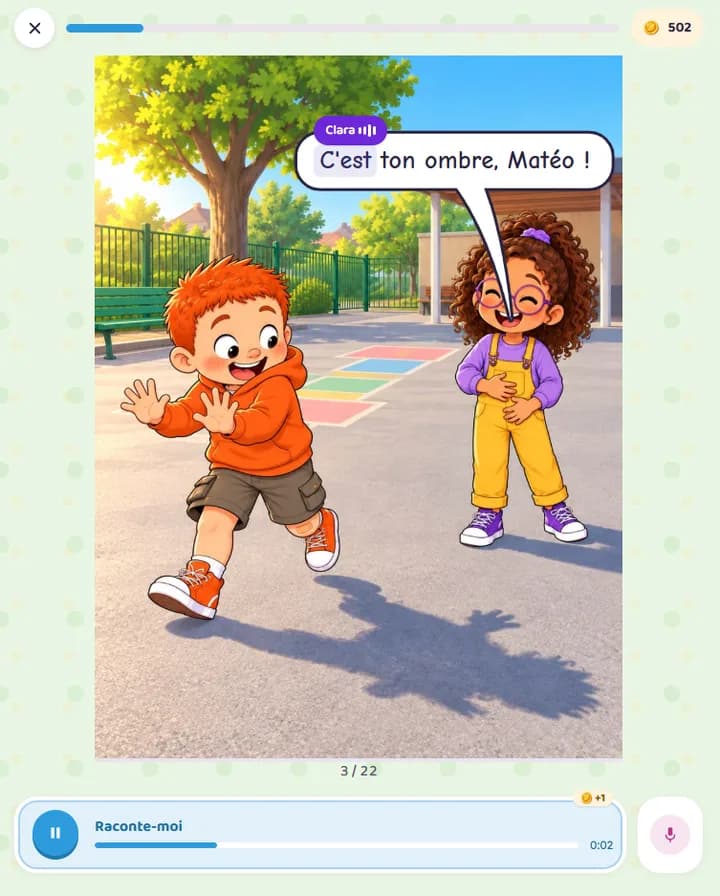
With « Raconte-moi » (Tell me), the story is read by the voices of its characters while your child follows the text, the word being read lighting up as it goes. They hear the words in front of their eyes, and each character's tone.
Reading aloud and following their progress
Then it is your child who reads the page aloud, and a tutor listens: each word read well turns green, a word misread, skipped or left silent turns yellow, and the next word lights up. The tutor never blocks your child and never says the word by itself; your child can, if they wish, tap a word to hear it. Listening needs an internet connection, and no recording of the voice is kept.
From your parent area, you see the week's reading time, pronunciation and the words to work on together. Kalimo replaces neither the teacher nor the speech therapist: it is extra practice, with no ads. To try it: Create an account.
FAQ: regional accents and learning to read
Can a child with a regional accent learn to read normally?
Yes. Learning to read means linking letters to sounds and understanding what you read; your child does it with their own pronunciation. The written word is the same in every region.
Should you correct your child's accent?
No. An accent is not a mistake in French. Correct instead the reading mistakes that change the meaning of a word, and leave their accent alone: correcting it all the time can make them lose confidence.
Why are some words not pronounced the same way everywhere in France?
Because French has evolved differently from one region to another. The surveys of the linguist Mathieu Avanzi show, for example, that « rose » is said rather with a closed o in the north and an open o in the south.
Does listening to several accents help understand French better?
Hearing other voices and other accents, in stories read aloud or in the family, shows your child that the same word can sound a little different and still be the same word. It is also a chance to talk with them about the richness of French regional accents.
How to tell a pronunciation trait from a real difficulty?
A pronunciation trait is shared with the people around the child and gets in the way neither of being understood nor of progressing in reading. A difficulty lasts, hinders reading or communication and does not improve with time: talk to the teacher, then the doctor.
Sources
- Ministère de l'Éducation nationale, « Programme de français du cycle 2 », annexe 3 de l'arrêté du 22 octobre 2024, Bulletin officiel n° 41 du 31 octobre 2024. https://www.education.gouv.fr/sites/default/files/document/Annexe%203%20%E2%80%93%20Programme%20de%20fran%C3%A7ais%20du%20cycle%202-403818.pdf
- Mathieu Avanzi, « Chocolatine ou pain au chocolat ? La science s'en mêle », Slate, 2017 (première publication : The Conversation). https://www.slate.fr/story/152828/chocolatine-ou-pain-au-chocolat-la-science-sen-mele
- Béatrice Rea, « Le nom de la rose ou l'épineuse question de la prononciation des mots français », The Conversation, 2017 (sur les cartes de Mathieu Avanzi). https://theconversation.com/le-nom-de-la-rose-ou-lepineuse-question-de-la-prononciation-des-mots-francais-80914
- Éduscol, « Le quart d'heure de lecture ». https://eduscol.education.gouv.fr/6336/le-quart-d-heure-de-lecture