
My child does not like reading: 7 tips to make them want to read
If your child does not like reading, start by looking for why: reading may still cost them too much effort, the books offered may not speak to them, or screens may take up all the room. Then 7 simple tips help them come back to it: choice, comics, varied formats, a short and regular reading time, your example, shared reading and conversations about books. And avoid forcing: that is what pushes children furthest from books.

Why does my child not like reading?
“They don’t like reading” often hides very different situations. Before looking for the solution, take a few days to observe. When your child refuses, what do they say? What do they do instead? Is there any reading they accept all the same: a comic, a magazine, the rules of a game?
Reading still takes them a lot of effort
For a child who decodes slowly, reading is tiring. The DEPP, the statistics department of the French Ministry of Education, recalls that automatic decoding frees up cognitive resources to build meaning. As long as each word takes an effort, there is little room left to enjoy the story.
This stage takes time. According to the same DEPP note, published in 2026, 40.3% of CE1 pupils assessed in France at the start of the 2025 school year (the second year of French primary school, age 7) reached the end-of-CP expectation, that is, reading at least 50 words correctly in one minute. So your child is not alone: many pupils are still making their reading automatic at the start of CE1.
The books offered do not speak to them
A child who only reads books chosen for school can end up believing that reading means doing homework. Yet they may love jokes, dinosaurs, football or scary stories. They simply have not yet found the book that speaks to them.
Screens take up all the room
According to the 2026 study by the French National Book Centre (Centre national du livre, CNL), carried out by Ipsos bva among 1,500 young French people aged 7 to 19, young people spend 18 minutes a day reading for leisure, against 3 hours 1 minute on screens. The same study states that preferring other activities is the main barrier to reading. So your child is no exception: books compete with very attractive activities.
Role models and shared moments are fading
The CNL also notes that in 2026, 18% of young people say their parents do not read books, against 7% in 2016. And parents reading stories aloud, rated very positively by everyone who had it, is becoming less frequent, including among 7 to 9-year-olds. The bright side of this finding: this lever is in your hands.
How to make your child want to read? 7 tips
1. Let them choose what they read
Take them to the library and let them choose, even what seems too easy or too “light” to you. The French “Children and screens” commission (commission « Enfants et écrans »), in its April 2024 report, in fact recommends strengthening reading among children by building on their habits and their tastes.
A story in Arabic counts too: at this stage, what matters is that they enjoy reading, in the language they prefer.
2. Offer them comics
Comics are often the best way in: according to the French National Book Centre, in 2026 they remain young French people’s first choice when they read for pleasure. To learn how to choose a comic and read it with them, read our article Learning to read with comics.
3. Vary the formats
Think too of children’s magazines, non-fiction, activity books and audiobooks. The “Children and screens” report lists reading, audiobooks and interactive stories among the stimulating alternatives to screens.
4. Set up a short, regular reading time
Better 10 to 15 minutes every evening than an hour on Sunday. Choose a calm moment, always the same one, for example after dinner or at bedtime. Turn off the TV and put away leisure screens (games, videos) during that time, yours included.
5. Read in front of them
Children imitate what they see. Read a novel, a newspaper, a recipe: it does not matter, as long as they see you read, and you talk about it from time to time. “I’m reading an amazing story, shall I tell you how it starts?”
6. Read with them, taking turns
You read one page, they read the next. Or you read everything and they only read one character’s lines. Your voice carries the story, their reading stays short, and the pleasure comes back. We describe this practice in the article Reading aloud every day.
7. Talk about books without setting an exam
After reading, the urge to check they have understood is strong. But a string of checking questions soon feels like a written test. Prefer real conversations, the ones you would have with an adult coming out of a film: “What made you laugh?”, “Would you have done the same as him?”, “What do you think will happen in the next book?” Share your own opinion too. A child who feels their opinion matters has a good reason to come back to the book.
What mistakes to avoid when your child refuses to read?
These reactions are natural when you are worried. Yet they tend to strengthen the refusal.
- Forcing or bargaining. “You’ll read for 20 minutes, or no tablet” turns reading into a chore and the screen into a reward.
- Making reading a punishment. “Go to your room and read” links books with being punished.
- Only offering “school” books. Comics, magazines and non-fiction are real reading.
- Correcting every word. A child interrupted all the time loses the thread, and the wish to read with it.
- Comparing. “Your sister was reading novels at your age” hurts without helping.
- Stopping reading them stories as soon as they can read. They still need it, to keep the pleasure of stories while reading alone still takes a big effort.
My 8-year-old does not read: a plan for the week
Here is a practical way to restart reading, without conflict.
- Monday: talk about it without blame. “I get the feeling reading isn’t really your thing at the moment. What bothers you?” Listen to the answer without correcting it.
- Tuesday: a trip to the library. They choose three things to read, in any format.
- Wednesday: the first 10-minute reading time. You read aloud, they follow or read every other line of dialogue.
- Thursday: they read you something short, a joke, a page of a comic, a recipe for dessert.
- Friday: talk about it. “Which character do you like best? Why?” No checking questions.
- The weekend: free reading, with no set length, while you read too.
If your child refuses one evening, do not insist: offer to read yourself, and start again the next day. Regularity counts more than length.
My child still refuses to read: when to worry?
Sometimes, “I don’t like reading” means “reading is too hard for me”. That is the case, for example, if your child avoids all reading, even the comics they like to look at, if they tire very quickly, if they often make up the words or if reading sets off tears or anger.
In these situations, do not stay alone with your questions. Talk to the teacher, who sees your child read every day and knows their results in the year’s assessments. If needed, then talk to the doctor, who can refer you to a speech and language therapist. Asking for advice is not putting a label on your child: it gives you the means to help them in the right place.
Frequently asked questions about children who do not like reading
Should you make your child read every day?
No: forcing is what pushes children furthest from books. Offer a short, regular reading time instead, and if they refuse one evening, read them the story yourself and start again the next day.
How many minutes should a child read each day?
Aim for 10 to 15 minutes each evening, at the same time. A short, regular time is better than a long session now and then.
Are comics really reading?
Yes. Reading a comic means reading the bubbles, following the order of the panels and linking the text to the pictures. It is also young French people’s favourite reading for pleasure, which makes it a good way in.
What if my child refuses to read altogether?
First look for why, without reproach, and keep reading stories to them. If they avoid all reading, tire very quickly or get angry as soon as they have to read, talk to their teacher.
And where does Kalimo fit in?
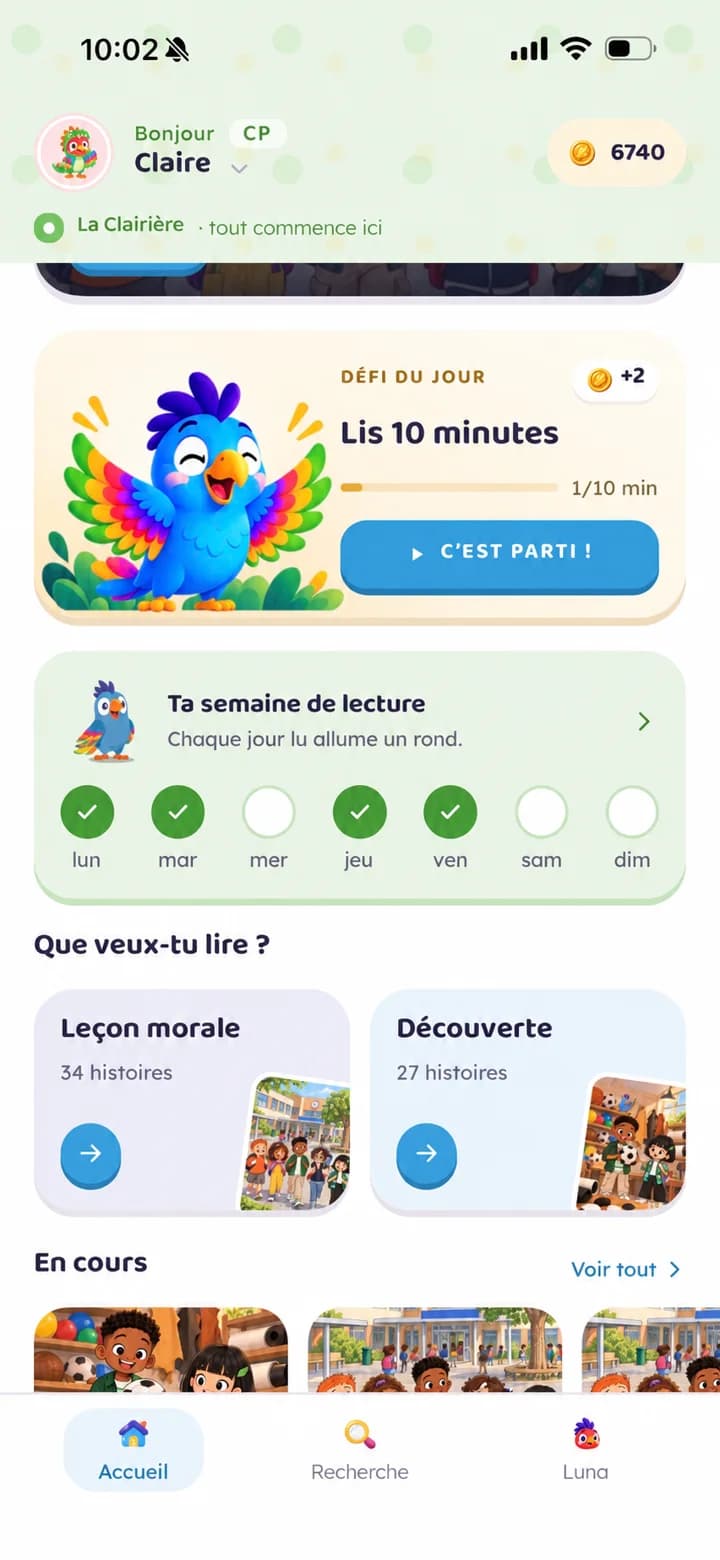
Kalimo is a French reading app for children aged 5 to 10, with illustrated stories in comic form, written for each school year, from CP to CM2.
Your child reads aloud and a tutor listens: every word read well turns green, a word misread, skipped or left silent turns yellow, and the next word lights up. The app never blocks them. With “Raconte-moi” (“Tell me”), the story is read by its characters’ voices while they follow the text, handy on evenings when you are busy.
As they read, they earn coins to feed and dress their parrot, with a streak of reading days to keep going. From your parent area, you follow their reading time for the week and the words to work on together. No advertising, coming soon to the App Store and Google Play: create your account on the website.
Sources
- DEPP, ministère de l'Éducation nationale, Note d'Information n° 26.31, « Fluence de lecture : une dynamique d'apprentissage plus forte à l'école qu'au collège », 2026. https://www.education.gouv.fr/sites/default/files/document/deppni-2026-31fluence-de-lecturepdf-518870.pdf
- Centre national du livre et Ipsos bva, « Les jeunes Français et la lecture », communiqué de presse, 2026. https://centrenationaldulivre.fr/sites/default/files/2026-04/%C3%89tude%202026%20-%20Les%20jeunes%20Fran%C3%A7ais%20et%20la%20lecture%20-%20Communiqu%C3%A9%20de%20presse.pdf
- Commission « Enfants et écrans », « Enfants et écrans. À la recherche du temps perdu », 2024. https://www.vie-publique.fr/files/rapport/pdf/293978.pdf